UPDATE
I have changed a few things instead of training my 1-year-old dog I'm training my 11-week old puppy. He is doing good and I'm excited to post the videos of him.Tuesday, June 20, 2017

Wednesday, June 14, 2017



Wednesday, May 24, 2017
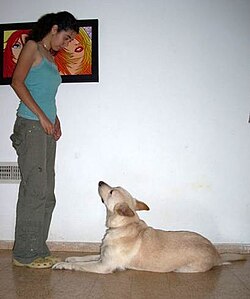
samantha's dog training week 2
This week I made five YouTube videos and I am uploading them at the end of this week and last week I made an introduction video but I didn't have time to post it, But so far it's been an amazing progress and I'm excited to share it with people. I hope they enjoy my videos.
My next steps in the project is to get more people with dogs to come to the park by my house so I can see their dogs progress from watching my videos and of course ill have a parent with me and if they live in the states I will leave my email so they can send me videos of how well their dogs are doing.
My next steps in the project is to get more people with dogs to come to the park by my house so I can see their dogs progress from watching my videos and of course ill have a parent with me and if they live in the states I will leave my email so they can send me videos of how well their dogs are doing.
Thursday, May 18, 2017
Samantha's dog training.
Samantha's dog training.
I decided on my project by seeing videos on YouTube and that inspired me. My project is making a series of YouTube videos about how to train your puppy. I need to train my puppy and make videos while training her. A question I have is "is your dog not listening?" and things I need to learn are to keep my dog focused on me.
Wednesday, March 29, 2017
What are some traditional games that kids would play from the 1850’s- 1900’s?
What are some traditional games that kids would play from the 1850’s- 1900’s?
http://www.ndstudies.org/resources/activites/es/pioneer.html
Traditional 1850s Games
With No Power How Did They Occupy Themselves - Games Of The 1850s
Today we play games for fun, relaxation, competition and interaction. In ancient times games were a way for people to develop skills that would help them thrive, work and survive. Games amuse and entertain us as well as improving our mental and physical skills. Students will rotate through a variety of games played by children of the 1850's, some of these include:
- Skipping
- Hopscotch
- Housey Housey
- Quoits
- Shove the halfpenny
- Rainy day games - Noughts and Crosses or Boxes
Games and Activities
of Pioneer Children
There were several games played by pioneer children that are still played today in homes, schools, and on the playground. Hide-and-Seek, baseball, jump rope, tag, and string games are just a few. Word games were played both at home and at school, because these games helped the children learn language skills. Games involving guessing were also popular, because these games were good brain exercises and helped students develop their thinking skills.
Directions are provided below for several of the games that were played during the early settlement era and are still played today. There are many more that are not covered; therefore, research more games pioneer children played. In addition, find out what types of toys the children of that time period played with to occupy any free time they may have had.
Outdoor Games
| ||
Indoor Games
| ||
Several web sites give directions for games played by pioneer children, along with the types of toys that were played with for entertainment.
Games and Activities
of Pioneer Children
There were several games played by pioneer children that are still played today in homes, schools, and on the playground. Hide-and-Seek, baseball, jump rope, tag, and string games are just a few. Word games were played both at home and at school, because these games helped the children learn language skills. Games involving guessing were also popular, because these games were good brain exercises and helped students develop their thinking skills.
Directions are provided below for several of the games that were played during the early settlement era and are still played today. There are many more that are not covered; therefore, research more games pioneer children played. In addition, find out what types of toys the children of that time period played with to occupy any free time they may have had.
Outdoor Games
| ||
Indoor Games
| ||
Nineteenth-Century Canadian Children's Game
Traditional Children's Games
7 Traditional, or "folk,"8 games played in Canada during the nineteenth century encompass games without objects, including rhyming and chasing games, and games with objects, such as hoop rolling. Many of these games were culturally widespread and their long and poorly documented use makes it difficult to determine a place or time of origin for them. As with other aspects of folk culture, basic play of these games has tended to remain stable over time with some development of regional variations.9 Although there is little documentation of nineteenth-century Canadian children playing these games, we can deduce that their contemporary presence in our school yards and playgrounds is a function of cultural tradition, based on British, American and European antecedents that have been illustrated and described (see figs. 1 and 2). Outdoor activities during the nineteenth century included many of the games children still play today, such as tag, skipping, hopscotch, hide and seek, leap frog, crack the whip, etc. Church picnics and civic celebrations advertised a number of organized events for children, including race competitions such as sack races and wheelbarrow races.
8 Singing games show a strong adherence to structure and cadence with variation in verse. Edith Fowke's collection of Canadian children's singing games made during the 1960s show antecedents in both Newell and Gomme. Counting out rhymes like:
Onery, twoery, ickery Ann
Fillisy, Follisy, Nicholas, John
Beaver, weaver, stingelum, steever,
O-U-T-spells, "out"10
which was reportedly used in Peterborough in 1875, show up in Fowke's collection as
Onery, twoery, ickery Ann
Fillicy, fallacy my son John
Quebum quavum English knavum
Stringle-um, strangle-um, BUCK!11
Her source dated its use to 1900 in Tintern, Ontario. Newell includes the following version used in New England about 1820:
Onery uery, hickory, Ann
Filisy, folasy, Nicholas John
Queevy, quavy, Irish Mary
Stingalum, stangalum, buck.12
Figs. 1, 2. Details of a painting Children's Games (1560) by Flemish painter, Pieter Brueghel. The painting illustrates scores of children's games, many of which, like leap frog and hoop rolling, continued to be played in the nineteenth century. The hoops are barrel hoops from large barrels like the one illustrated.


9 Other singing games, such as London Bridge, I Sent A Letter to My Love, A Tisket A Tasket, In and Out the Windows, etc., which many of us know from our own youth, are recorded in both Newell and Gomme. Forms of these games and skipping rhymes were probably part of the répertoire ot many nineteenth-century English-speaking Canadian children. Observation of recent changes in these types of rhymes may provide us with insight into how these changed and developed with modification of words contrasting with permanence of structure and nine. A skipping rhyme that I knew as a child had a very old cadence but a contemporary popular theme: "Hopalong Cassidy How About a Date?" Today children sing "Hey Fonzy!, How About A Date?"13 Many of the words of the original have been maintained, and the skipping game is still the same. The best sources on singing, rhyming and outdoor games in the nineteenth century are Fowke, Gomme, Newell and Brewster.14
10 Traditional children's games often use found, handmade, or locally made objects in the play, although a handmade game item does not necessarily mean that it is traditional. The corollary of this is also true: commercially, mass-produced game items may be traditional in form and use.
https://journals.lib.unb.ca/index.php/MCR/article/view/17246/22760

Wednesday, February 15, 2017
Pakistan it may look rich but it's not it's something way different.
The health care in Pakistan isn’t free. The poor quality of the government provided health services. The education isn’t that great since More than 3 million girls are not in school are girls. As Malala Yousafzai's shooting last year demonstrated. A lot of communities don’t let girls in school because of that. The jobs are not that great either the jobs they have are farming and selling meat but the three good jobs are government sector, computer and banking. Some poor people will be getting better jobs than farming or selling meat in around the year of 2050 . Which is good because than there won’t be as many poor people. 
Some consequences that might accrue in the next few years are some but not all poor people are going to be at war. Another consequence is a nine years old girl was married to an old man because her father was unable to return a loan that he had taken from her husband. At twelve years of age, she was divorced by her husband because she had given birth to a baby girl. After the divorce, her family did not accept her and due to social stigmatization and she attempted suicide. Every day we read in newspapers and on television about various cases of early marriages and we can’t do anything about it.
Subscribe to:
Posts (Atom)